Brisbane dwelling values fell 2.0% in October 2026 and now sit 8.3% below their May peak. Two days ago the Reserve Bank lifted the cash rate to 4.85%, the fifth rise this year. Rents are moving the other way: up 7.2% in a year on a 0.9% vacancy rate. This update puts the numbers in one place, explains what is driving them, and works through what they mean if you are buying in the next six months.
October in one table
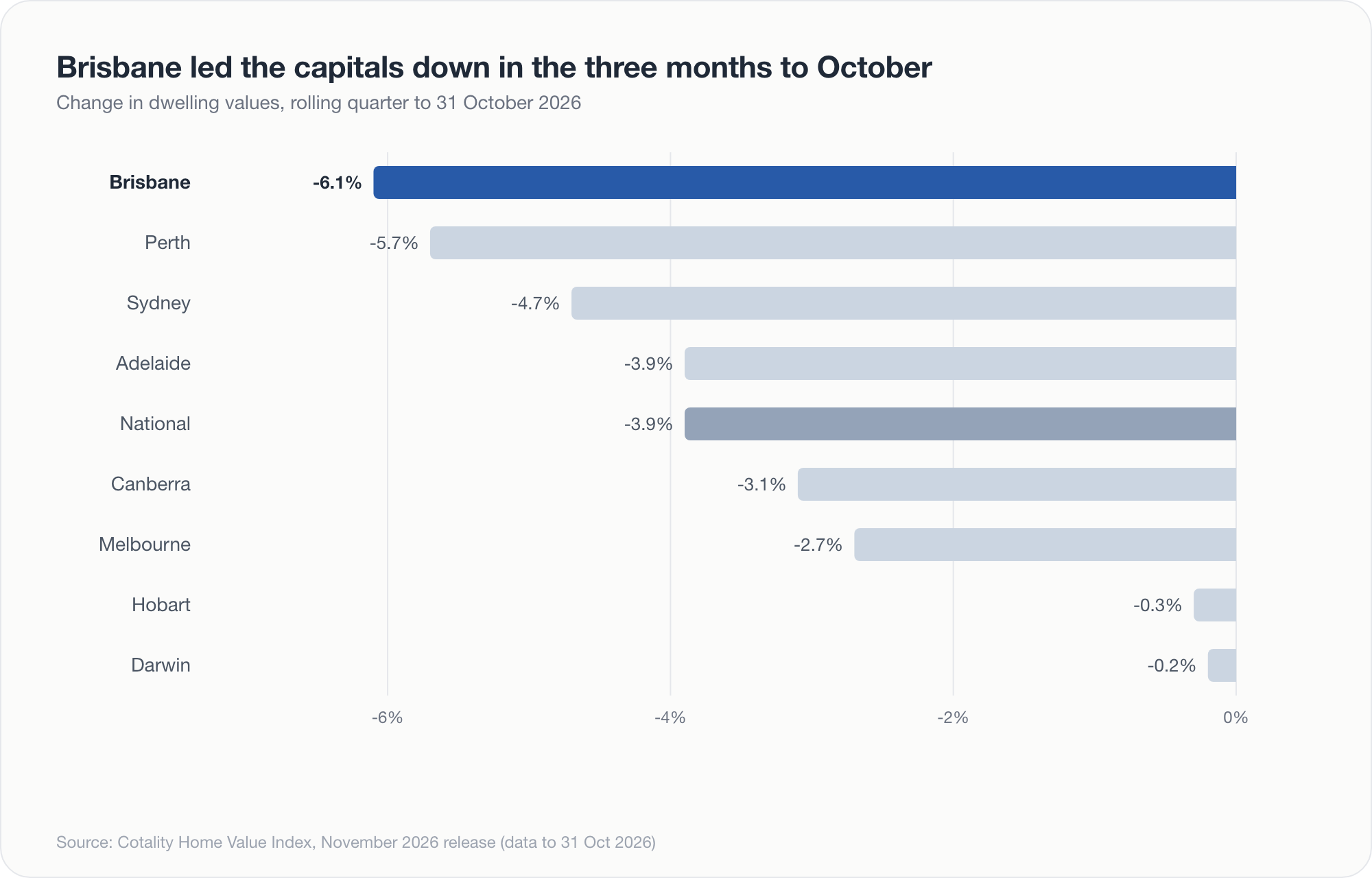
Cotality's Home Value Index for October, released on 2 November, recorded the seventh straight monthly fall nationally. Brisbane fell faster than any other capital for the second month running.
| Greater Brisbane, to 31 October 2026 | Figure |
|---|---|
| Change in October | -2.0% |
| Change over the quarter | -6.1% |
| Change since 1 January | -3.0% |
| Change over 12 months | +0.4% |
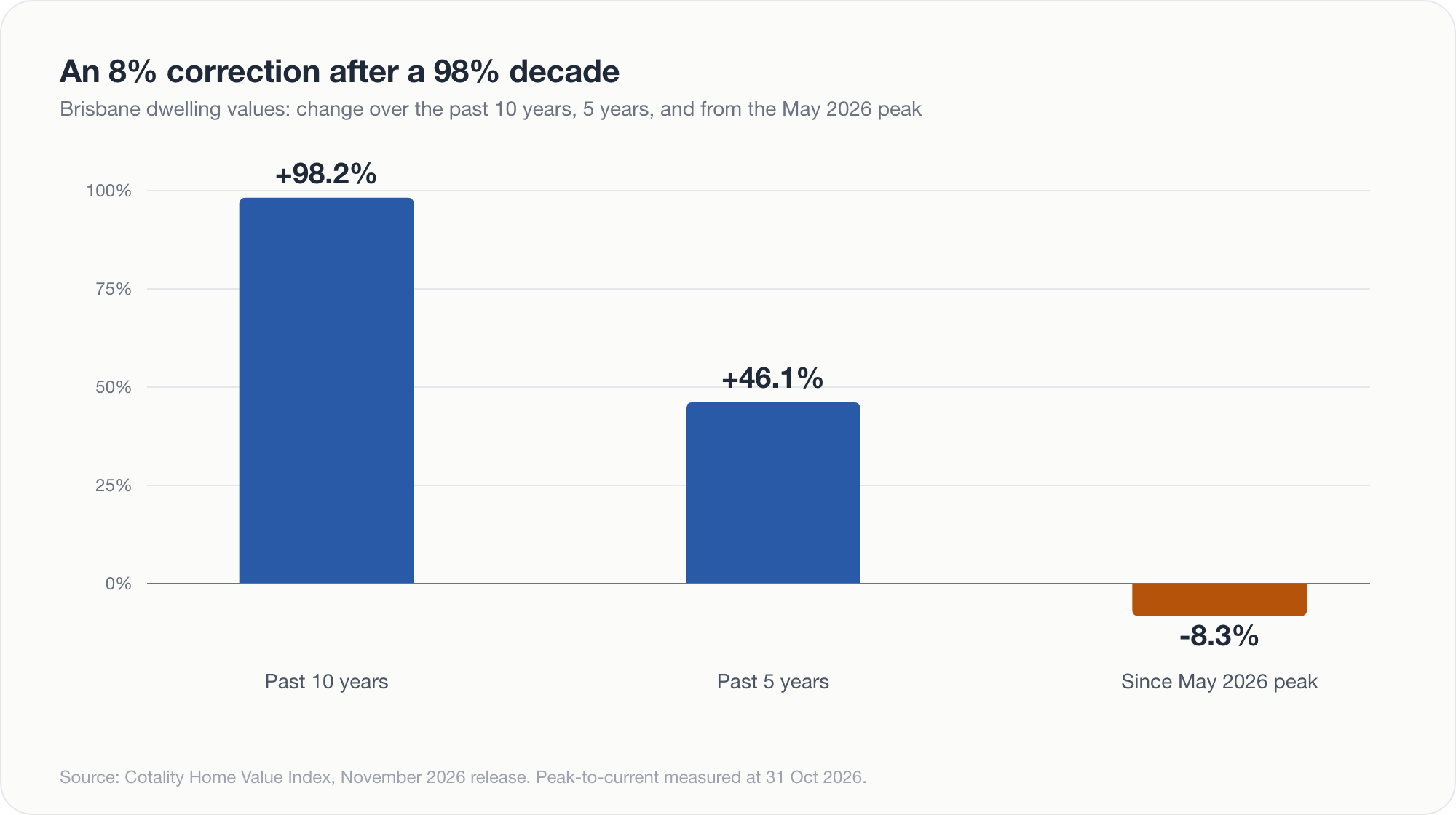
| Below the May 2026 peak | -8.3% |
| Median dwelling value | $1,018,401 |
| Gross rental yield | 3.7% |
| Sales, past three months vs a year ago | -29% |
A year ago Brisbane was growing at double digits. Annual growth has now rounded down to almost zero, and values are about 3% below where they started 2026. Perth and Sydney are close behind on the way down, and every capital except Hobart and Darwin lost ground over the quarter.
 Why values are falling: borrowing power, not demand for housing
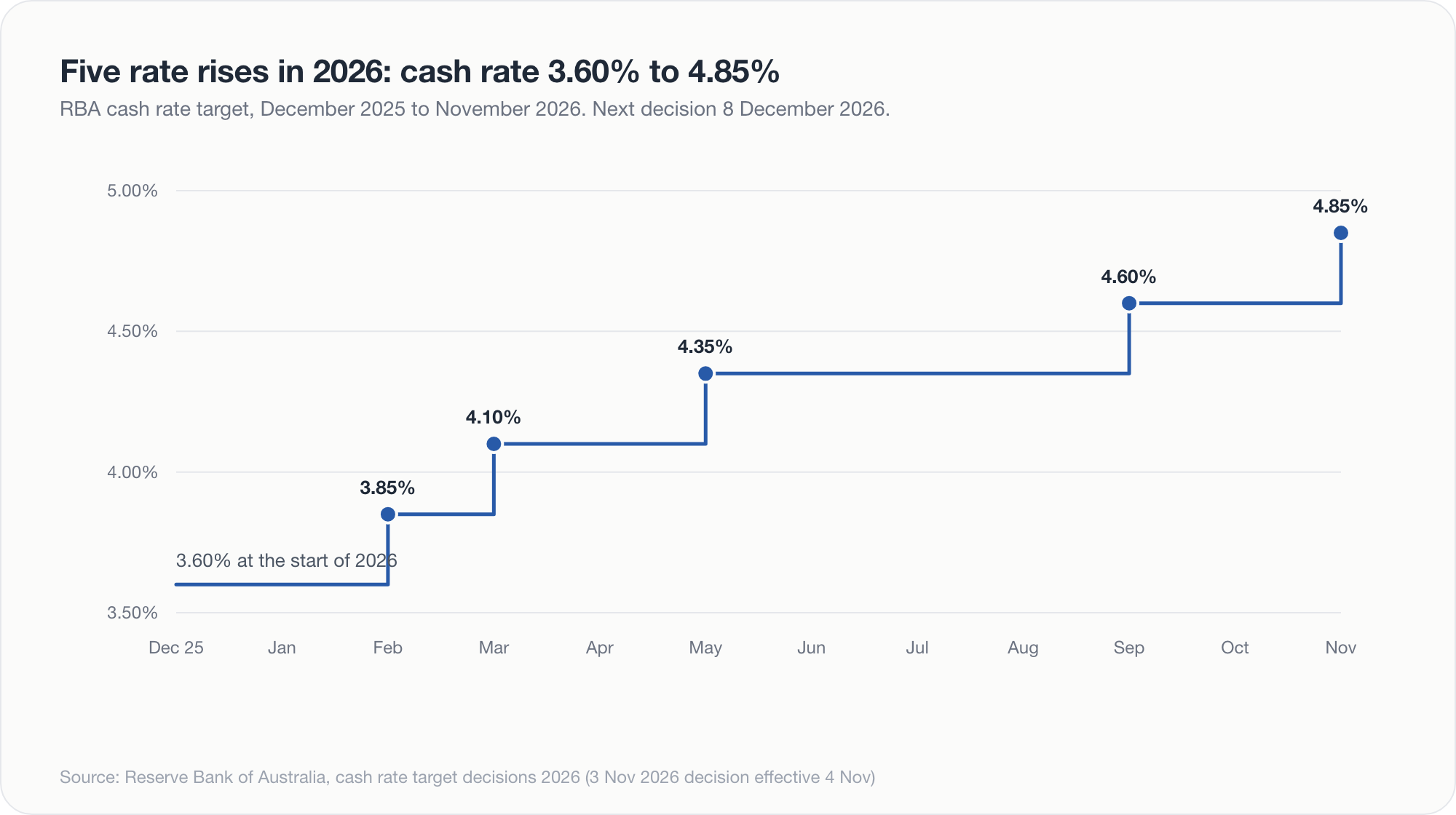
The cash rate started 2026 at 3.60%. After rises in February, March, May, September and November it is 4.85%, the highest since 2008. The November decision was a 6-3 split, and the Board's statement dropped its earlier line about raising rates further if needed, but Governor Bullock left the door open. The next decision is on 8 December. Most economists expect a pause over summer, with a further rise in early 2027 still possible if inflation does not turn.
 Inflation is the reason. Headline inflation was 4.3% in the year to September and the trimmed mean 3.7%, both well above the 2 to 3% target. Unemployment has risen to 4.7%.
For a buyer the mechanism is simple. Cotality estimates the hiking cycle has cut borrowing capacity by about 11.5%, or more than $105,000 for a typical borrower, which is more than the $63,400 the national median dwelling has lost since March. The average variable rate for an owner-occupier is now about 6.7%. In other words, prices have fallen but for anyone who needs a loan the home has not got cheaper. Test what the new rate does to your repayments below.
Principal & interest, indicative only — lender criteria differ.
Compare live rates from 20+ lendersKeep the fall in proportion
An 8.3% fall sounds dramatic until you put it beside the run-up. Brisbane values are up 46% over five years and 98% over ten. Cotality's point is that most owners in the mid-sized capitals are "sitting on a significant equity buffer", which is why forced selling has not appeared: listings are rising because homes take longer to sell, not because owners are being pushed out.
 Cotality's own base case is "a gradual drift lower in housing values rather than a more material downturn", with the risks skewed to the downside and the path depending on inflation, rates and jobs. Nobody is forecasting a return to growth before rates turn.
Houses and units are not the same market
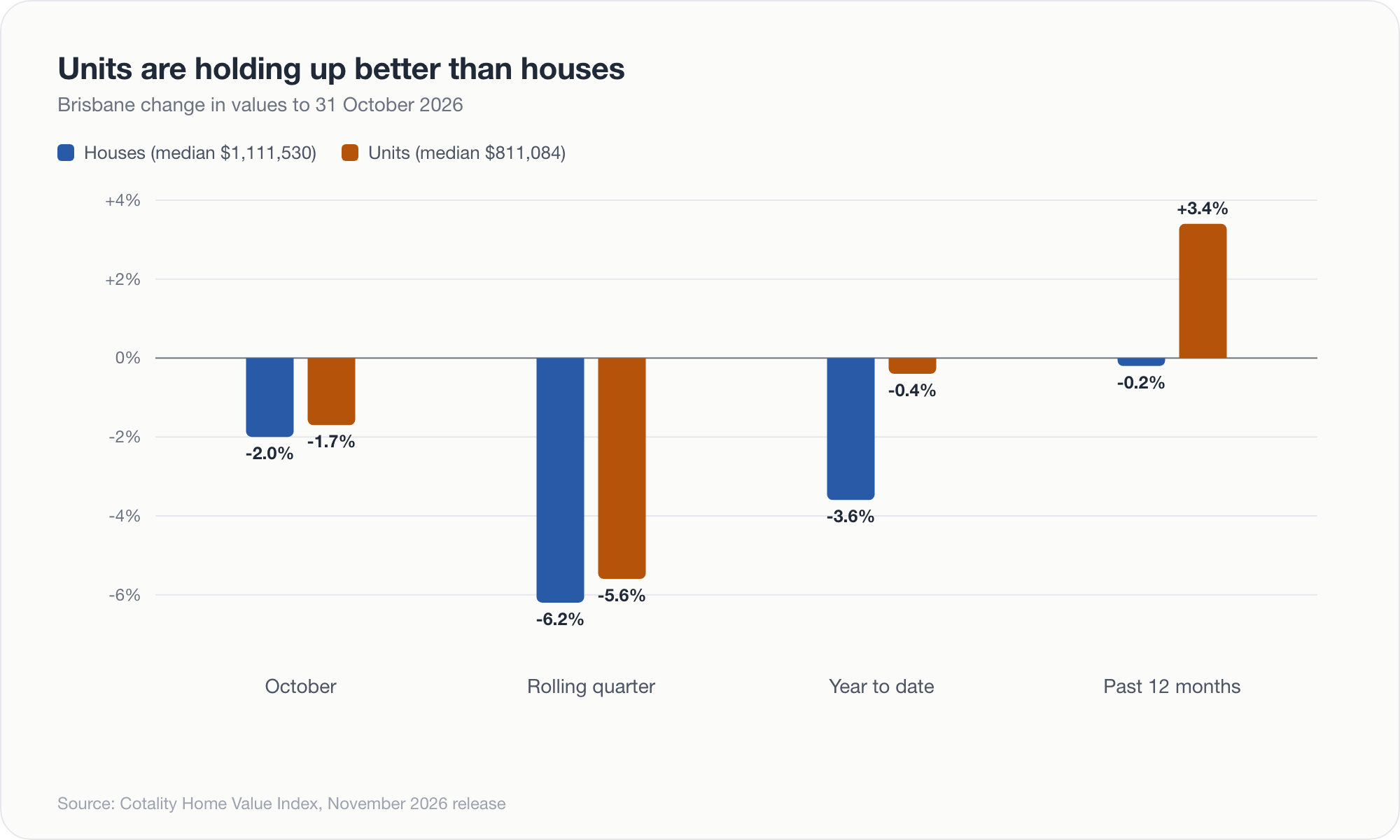
The split that showed up in September has widened. Brisbane houses are down 0.2% over the year and 3.6% since January. Units are up 3.4% over the year and almost flat since January. The reason is the same one driving the whole correction: buyers are trading down to what they can finance, and a unit at a median of $811,084 is a $300,000 smaller loan than a house at $1,111,530.
 Brisbane, October 2026 | Houses | Units |
|---|---|---|
| Median value | $1,111,530 | $811,084 |
| Change over 12 months | -0.2% | +3.4% |
| Change since 1 January | -3.6% | -0.4% |
| Gross rental yield | 3.5% | 4.3% |
For an investor the yield line matters most. A unit yields 4.3% gross against 3.5% for a house, and with rents still rising that gap is widening. Check the yield on any listing you are weighing up:
Before loan costs and tax — model the full picture in the analyser.
Open the full cash flow analyserA buyer's market in everything except rent
Every selling indicator now favours the buyer. Brisbane sales are down 29% on a year ago. Total homes advertised are up about 60%, yet new listings are down 4%, so the extra stock is homes that have not sold, not a wave of new sellers. The median time to sell a capital city home is 39 days against 23 a year ago, vendors are discounting an average 4.7%, and Brisbane's preliminary auction clearance rate for the week to 1 November was 26%, the lowest of the capitals.
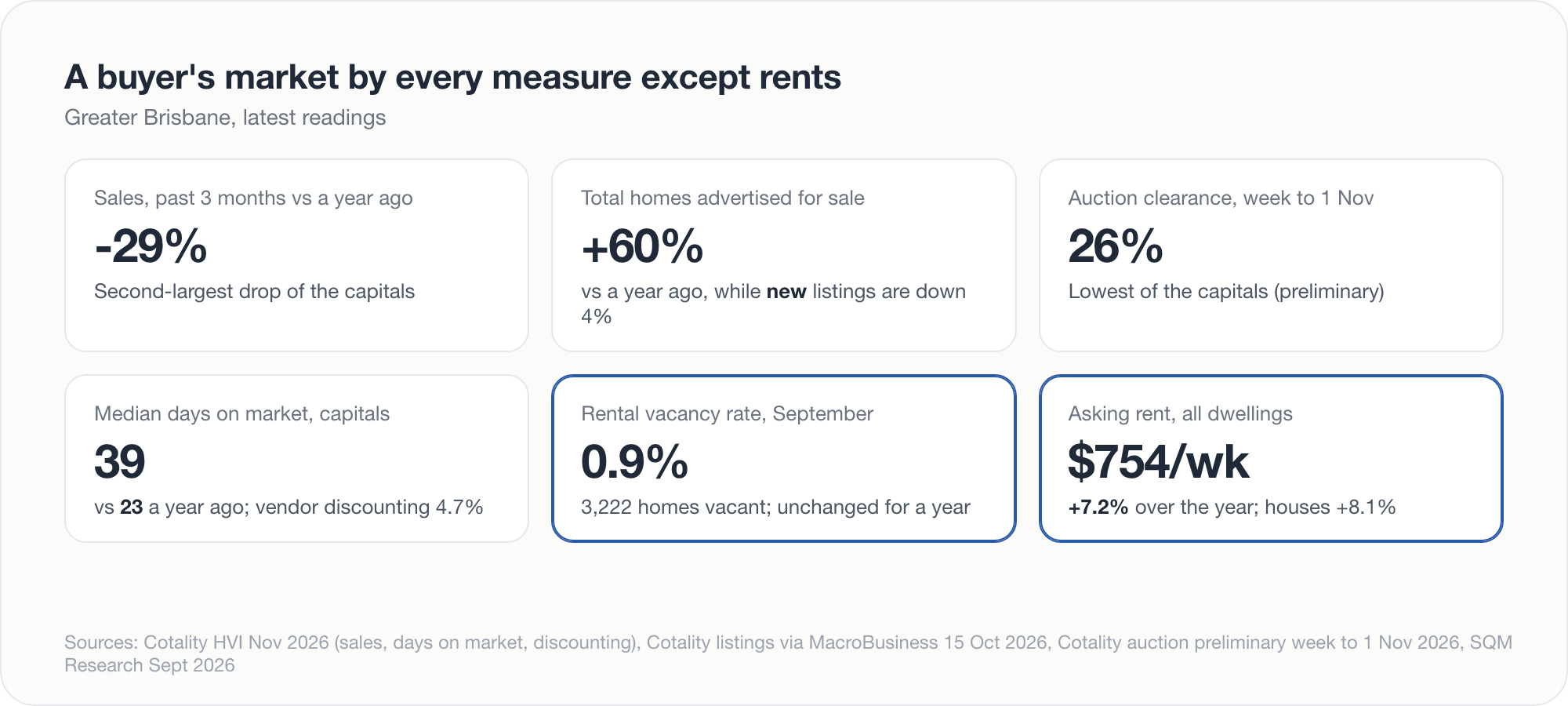 The rental side has not moved. SQM Research's September figures put Brisbane's vacancy rate at 0.9%, unchanged for a year, with 3,222 homes available. The combined asking rent is $754 a week, up 7.2% over the year, and house rents are up 8.1%. Tim Lawless at Cotality summed up the sales side: buyers "have more leverage and there isn't the same urgency to buy", yet they are noticeably absent.
That absence is the opportunity. The discounts are being offered to the few buyers who turn up prepared.
What is holding the floor
Two things stop this becoming a rout. The first is supply. Queensland had 52,567 homes under construction at the end of June 2026, up 35.6% in two years, but builders completed 34,627 dwellings in the year to June against 45,865 started, and apartment approvals swing wildly month to month. New homes are reaching the market slowly and at high cost. The second is population growth, which has slowed but is still positive, adding to demand for a rental stock that is already 99% occupied.
These are the same fundamentals we described in the spring update, and they explain why rents are rising through a price correction. They do not set a floor on prices this month. They do mean that when borrowing capacity recovers, there will not be a backlog of empty homes waiting for it.
Buying strategy: think in terms, not timing
Trying to pick the bottom month is a coin toss, and in this cycle the thing that makes homes affordable, the interest rate, is moving against you while the price moves for you. The better question is which constraint binds you, because the strategy differs for each.
If your limit is what the bank will lend
This is most first home buyers and most upgraders carrying a large loan. For you the market is not getting cheaper: each 0.25% rise takes more off your maximum loan than a month of price falls gives back. Waiting for a lower price while rates climb is a bet that prices fall faster than capacity, and so far they have not. Buy what you can service with at least a one-point buffer above today's rate, and do not let a lender's maximum become your budget. First home buyers have an extra edge: a new home under $750,000 still attracts the $30,000 grant and zero transfer duty, which no established home does. The details are in our first home buyer guide.
If your limit is deposit, or you have none
Cash buyers, downsizers and anyone with a large deposit have the strongest hand in years. Price falls are pure gain to you because you are not borrowing against the rate. Use the leverage: the 4.7% average discount is an average, and the deeper cuts sit in the stale stock that makes up the 60% jump in listings. Ask how long a home has been listed, make offers below the guide with a short expiry, ask for a 60 to 90 day settlement if that suits you, and keep finance and building inspections as conditions. Vendors are meeting the market, but only when a real offer is on the table.
If you are investing
Run the cash flow at 6.7%, not at the rate you hope for in 2028. A Brisbane unit at 4.3% gross yield with rents rising 7% a year is closer to covering itself than at any time since 2021, and the purchase calculator will show you the weekly gap after tax. Then look at the tax rules, because they now decide what you buy. From 1 July 2027, rental losses on an established home bought after 12 May 2026 can no longer be set against your salary, while a new dwelling keeps full negative gearing and depreciation. The bill passed Parliament in June; the definition of a "new residential dwelling" is still to be set by regulation, with Budget material pointing to a home bought from the builder and not lived in for more than 12 months. Our negative gearing guide covers the detail. The strategic point is this: when rates eventually ease and investors return, the tax rules will send them to new stock. Buying new now, at a negotiated price, puts you ahead of that queue.
If you are buying off the plan
An off-the-plan contract fixes your price today and settles in 2027 or 2028, so the market risk is the bank's valuation at settlement. If values are lower then, you make up the gap in cash; the price does not change. Three things protect you. Negotiate the price now against today's resales, not last year's price list, and ask for rebates or inclusions where the developer will not move on price. Hold a cash buffer of around 10% of the price beyond your deposit. Read the sunset clause and the finance timing, because a two-year settlement spans at least eight RBA meetings. The upside is the mirror image: if rates have fallen by settlement your repayments fall and your price does not rise.
 What to watch between now and March
- 8 December: the RBA's last decision of the year. A pause would steady sentiment; a sixth rise would extend the correction.
- 1 December and 1 January: Cotality's monthly index. Watch whether Brisbane's monthly fall shrinks from 2.0%.
- Mid-month: SQM vacancy rates. Brisbane rising above 1.5% would be the first sign of rental relief; it has not happened in a year.
- Late January: the December quarter inflation print, which sets up the February rate decision.
- Any time: the regulation defining a "new residential dwelling" for the negative gearing rules.
Prices are falling, borrowing power is falling faster, and rents are rising. Buy on terms you can service, negotiate like the market says you can, and if you are investing, buy new.
If you want to talk through where your own numbers land, the PVI team can walk through the current projects on our listings page with today's pricing, not last year's.
This article is general information only and not financial, legal or tax advice. Figures are correct at the date of writing (5 November 2026) and change monthly; check the source or speak to a licensed adviser before acting.
Source: Cotality, Home Value Index November 2026 (data to 31 October 2026), released 2 Nov 2026 — https://discover.cotality.com/hubfs/COTALITY%20HVI%20NOV%202026%20FINAL.pdfSource: Cotality, "Housing downturn broadens as Brisbane and Perth lead the decline", 2 Nov 2026 — https://www.cotality.com/au/insights/articles/housing-downturn-broadens-as-brisbane-and-perth-lead-the-declineSource: ABC News, "RBA lifts interest rates to highest level in 18 years", 3 Nov 2026 — https://www.abc.net.au/news/2026-11-03/rba-lifts-interest-rates-november-2026-highest-rate-in-18-years/107340050Source: SQM Research, national vacancy rates September 2026, via AdviserVoice 14 Oct 2026 — https://www.adviservoice.com.au/2026/10/national-vacancy-rate-rises-to-1-4-house-and-unit-rents-diverge-as-sydney-shows-signs-of-easing/Source: MacroBusiness, "Stale property listings pile up across Brisbane" (Cotality listings data), 15 Oct 2026 — https://www.macrobusiness.com.au/2026/10/stale-property-listings-pile-up-across-brisbane/Source: ABS Building Activity, June quarter 2026 (Queensland commencements, completions and dwellings under construction) — https://www.abs.gov.au/statistics/industry/building-and-construction/building-activity-australia/latest-releaseSource: Corrs Chambers Westgarth, "Capital gains tax and negative gearing amendments", 3 Jun 2026 (Treasury Laws Amendment (Tax Reform No. 1) Bill 2026) — https://www.corrs.com.au/insights/capital-gains-tax-and-negative-gearing-amendments-key-changes-and-implications